Do you ever feel like your brain’s “energy bar” is depleted by the end of the day? Does it seem like if you had to answer one more email or finish one more task, your mind would shut down? If so, you are not alone, and there is a reason for that. Contrary to what many believe, our beautiful, complex minds aren’t fueled by stardust and can’t operate at full speed 24/7.
Just as a video game character's energy depletes after intense action, our mental capacity diminishes after a day of making decisions, whether big or small. For instance, judges granted parole 65% of the time in the morning but almost none by the end of the day, simply because they were mentally exhausted (Danziger et al., 2011). This phenomenon, called decision fatigue, affects everyone and can lead to poor choices or mental gridlock. In this post, we’ll explore five ways decision fatigue drains your mind and share modern psychological and mindful strategies to help you recharge.
Let's dive in and clear the mental fog!
Our Minds Aren’t Perpetual Motion Machines
Our minds aren’t designed to function at full capacity all day, every day. In fact, they work best in 20 to 45 minute increments followed by a short recovery period (Bailey & Konstan, 2006). Forcing ourselves beyond this interval leads to a significant drop in performance. A 2020 study found that repeated decision-making tires the brain and reduces physical endurance. In the experiment, lab participants struggled to tolerate discomfort after making a series of decisions (Pignatiello et al., 2020).
Imagine your mind as a video game’s “special power bar” that slowly depletes as you tackle tasks, burning faster during more complex decisions, such as crafting a work email or choosing a healthy dinner. You might be all too familiar with coming home after a long day at work, only to spend minutes staring at Netflix because you're too drained to pick a show. Decision fatigue sets in when our mental energy is low, making even small choices feel overwhelming.
It Pushes Us Toward Sloppy Decisions
As our “special power bar” depletes, our decisions get sloppier. In the case of parole hearings, for example, favorable parole decisions plummeted from 65% at the start of a session to nearly 0% by its end, rebounding after a midday break (Danziger et al., 2011). Fatigued judges defaulted to the "safe" choice of denying parole because their brains couldn't handle complex reasoning.
Have you ever bought junk food at the store because you were too tired to plan a meal? When decision fatigue sets in, our minds rely on mental shortcuts, leading us to make impulsive or comforting choices. This is why self-help books like Brian Tracy's "Eat That Frog!: 21 Great Ways to Stop Procrastinating and Get More Done in Less Time" urge us to tackle big tasks early in the morning, when our minds are at their best.
It Leaves Our Minds “Depleted” and Overloaded
Have you ever noticed a mental "soreness" after pushing your brain to its limits, making one decision after another? Solving a problem doesn't leave our mind on a clean slate. Rather, it lingers and builds up as the day goes on. A 2019 study linked decision fatigue to low self-efficacy, finding that constant decision-making erodes confidence, making even small tasks feel daunting (Kurtovic et al., 2019). This cognitive overload traps us in a cycle where our brains feel flooded with “parasitic” thoughts that drain the resources needed for fresh ideas. It's no wonder that sparking creativity or solving problems becomes almost impossible in the evening!
Professionals Feel the Burn, Too
Decision fatigue isn’t just a personal struggle. It affects everyone, from teenagers to seasoned professionals in high-stakes roles. During the COVID-19 pandemic, 70% of frontline nurses reported impaired decision-making due to decision fatigue, increasing burnout and patient care errors (Pignatiello et al., 2022). Similarly, the accuracy of daily forecasts issued by financial analysts dropped by 6% due to mental exhaustion (Hirshleifer et al., 2019).
Whether you're a student, teacher, manager, or parent, making relentless decisions without breaks often leads to mistakes. Have you ever sent a typo-filled email late in the day? That was your fatigued brain struggling to keep up as the mental soreness from earlier tasks lingered, clouding your judgment.
How to Recharge Your Mental Power Bar
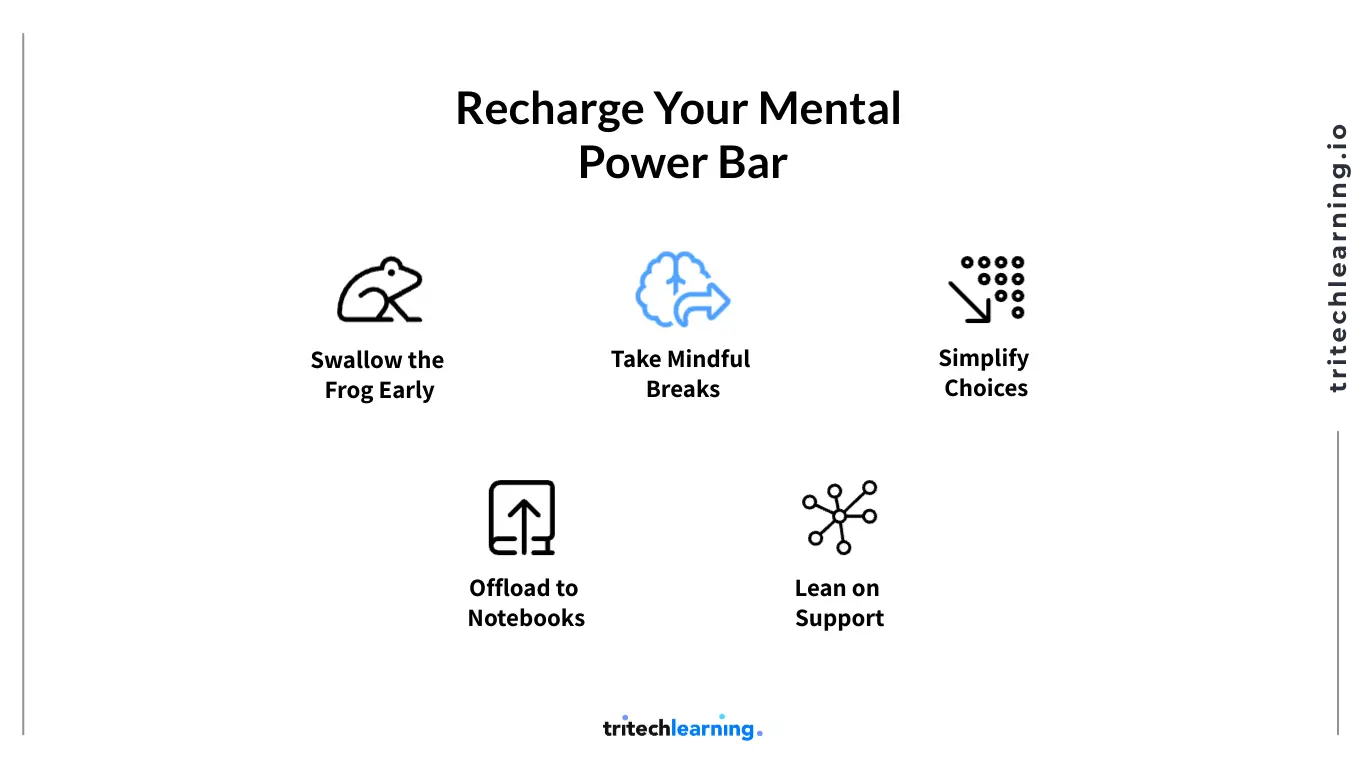
Recharge Your Mental Power Bar
Although decision fatigue can be mentally exhausting, we can recharge by using these research-backed strategies. Here are five ways to keep your brain sharp, inspired by psychology and real-life insights:
Swallow the frog early
As many productivity experts suggest, it helps to tackle your most important task at the start of the day when your “mental power bar” is fully charged. Early mornings offer some of the strongest cognitive resources you will have, which means you can handle demanding work with greater clarity and efficiency. Writing a business report before lunch, for example, allows you to use your peak mental sharpness rather than forcing yourself to complete it when your energy has already dropped.
Simplify choices
Reducing small, repetitive decisions can preserve mental energy for what truly matters. Barack Obama famously minimized his wardrobe options so that he could focus his mental resources on more consequential responsibilities, a principle supported by research on decision fatigue (Pignatiello et al., 2020). You can apply the same idea by planning your meals or outfits for the week. Fewer trivial choices mean more cognitive strength available for meaningful tasks.
Take mindful breaks
Short, intentional breaks restore mental clarity far more effectively than pushing through exhaustion. A well-known study on judges’ parole decisions found that their likelihood of granting parole rebounded to around sixty-five percent after breaks, demonstrating the restorative power of rest (Danziger et al., 2011). A five-minute meditation, a brief walk, or a moment of quiet reflection can help clear “parasitic” thoughts and reset your focus for the next phase of work.
Offload to notebooks
When your mind becomes crowded with loose ideas, reminders, and unfinished thoughts, mental fatigue increases. Writing these down in a notebook or digital tool creates structure and frees your attention. This simple practice helps reduce internal clutter and opens cognitive space for new insights, a principle echoed in mindfulness approaches that emphasize externalizing thoughts to regain clarity.
Lean on support
Mental energy is not only an individual resource; it is also influenced by the quality of our support systems. Research during the COVID-19 pandemic showed that nurses with strong family or financial support experienced less decision fatigue (Pignatiello et al., 2022). Delegating tasks, asking for a colleague’s input, or seeking emotional support from a friend can reduce cognitive strain and help you recover your mental bandwidth more quickly.
Decision fatigue silently depletes your mental energy, leaving you vulnerable to poor choices, mental exhaustion, and professional mistakes. Fortunately, we can recharge our brains and make sharper decisions by swallowing the frog early, simplifying choices, practicing mindfulness, offloading to notebooks, and leaning on support. Even though human minds aren’t perpetual motion machines, these strategies can help them run smoothly.
Growth begins with curiosity! At Tri Tech Learning, you’ll find free courses, webinars, presentations and articles that help you understand yourself and grow with purpose. To advance even further, explore our premium courses, workshops, and 1-on-1 coaching sessions, each designed to turn insight into meaningful, lasting change.


 Self‑paced