

People Pleasing and High Agreeableness
- Have you ever caught yourself in the middle of a social event or meeting, silently stressing with thoughts like, “Will they still like me if I say this?” or “What can I say to come across as likable to that person?” It’s a surefire way to turn any interaction into a stressful, anxiety-inducing ordeal, making it feel like more work than pleasure. As it turns out, about 49% of Americans describe themselves as people-pleasers, with 56% of women and 42% of men reporting difficulty saying “no” (YouGov, 2022). This constant need to please can feel like walking a tightrope while juggling flaming torches. Let’s unpack why this matters, where it comes from, and how to break free from its grip.
What's the Problem with Being a People Pleaser?
- “People pleasing” isn’t just a quirky habit. It is a behavior that gradually wears down our mental health, damages relationships, and hinders personal growth. According to recent surveys, 50% of people who identify as people-pleasers say it makes their lives harder (YouGov, 2024). It is associated with higher reported stress and burnout risk. For example, some findings suggest up to a 40% increase in stress and a 25% rise in burnout risk for those who regularly avoid conflict or overextend themselves (CNBC, 2023). Physically, it may contribute to habits like overeating or chronic fatigue. In relationships, always putting others first can eventually breed resentment. Unmet needs are cited as a source of conflict by 60% of couples. At work, "people pleasing" becomes a hidden career blocker. We might find ourselves overwhelmed with tasks simply because we agreed to everything. Understanding "people pleasing" and its connection to high agreeableness matters because doing so allows us to reclaim our time, energy, and peace of mind.
Common Situations Where People Pleasing Shows Up
- People pleasing creeps into everyday situations, often with messy results. These moments waste our time, drain our confidence, and leave us feeling mentally overloaded. Social Settings In social environments, people pleasing often shows up as constant self-monitoring. You might find yourself at a party replaying every sentence in your mind, wondering whether you sounded awkward or whether someone misinterpreted your tone. Instead of enjoying the moment, your attention shifts inward and becomes consumed by self-evaluation. Over time, this turns simple interactions into exhausting mental work. It can feel like walking a tightrope in flip-flops, always trying to maintain balance while never feeling fully stable or natural. Workplace At work, people pleasing can turn into a pattern of automatic yes responses, especially when requests come from colleagues or supervisors. Even when your schedule is full, you may feel pressure to take on more because you do not want to disappoint others or appear uncooperative. Research shows that individuals high in agreeableness are twenty percent less likely to negotiate their salaries (Graziano et al., 1996), illustrating how this trait influences real-life outcomes. Certain work environments may even rely on or exploit this tendency, consciously or unconsciously assigning more tasks to the people who rarely push back. Relationships In personal relationships, the habit of avoiding conflict can become deeply ingrained. You might silence your preferences around family or partners because you assume that being agreeable will make you more likable or easier to love. This self-silencing often feels protective in the moment, yet it gradually erodes emotional connection. Research shows that about seventy percent of couples who avoid conflict report lower relationship satisfaction, largely because unresolved needs accumulate and genuine intimacy becomes more difficult to maintain. Decision Paralysis Decision paralysis is another subtle form of people pleasing. A simple situation, such as choosing a restaurant, can spiral into endless back-and-forth questions meant to accommodate the other person: “What do you want to eat? Are you sure that works for you?” What begins as politeness becomes an energy-draining loop. A clearer approach tends to be far more effective. Offering a specific preference, such as “I would like burgers. Would that work for you?”, gives the other person something concrete to respond to and reduces unnecessary tension. Both people feel more relaxed because someone has anchored the decision.
Where Does It Come From?
- People pleasing often has roots in childhood. Surveys suggest that 38% of women and 25% of men say they were raised to prioritize the needs of others (YouGov, 2022). Personality also plays a role. People high in agreeableness tend to value empathy and harmony, making them more likely to avoid conflict. However, this can backfire. Some research shows that agreeable individuals may be more tolerant of unfair treatment (LePine & Van Dyne, 2001), although findings are context-dependent and should be interpreted with caution. Modern cultural influences also reinforce the pattern. Today’s social dynamics often reward diplomacy and discourage directness, sometimes causing people to self-censor in ways that elevate anxiety (Alterman et al., 2022). It becomes a mix of nurture, personality traits, and external social pressure. Every day, we are faced with decisions that pull from our mental energy. This extra effort quickly adds up. Before we realize it, everything begins to irritate us more easily and wears down our emotional well-being.
How Can We Fix This?
 Stopping People Pleasing
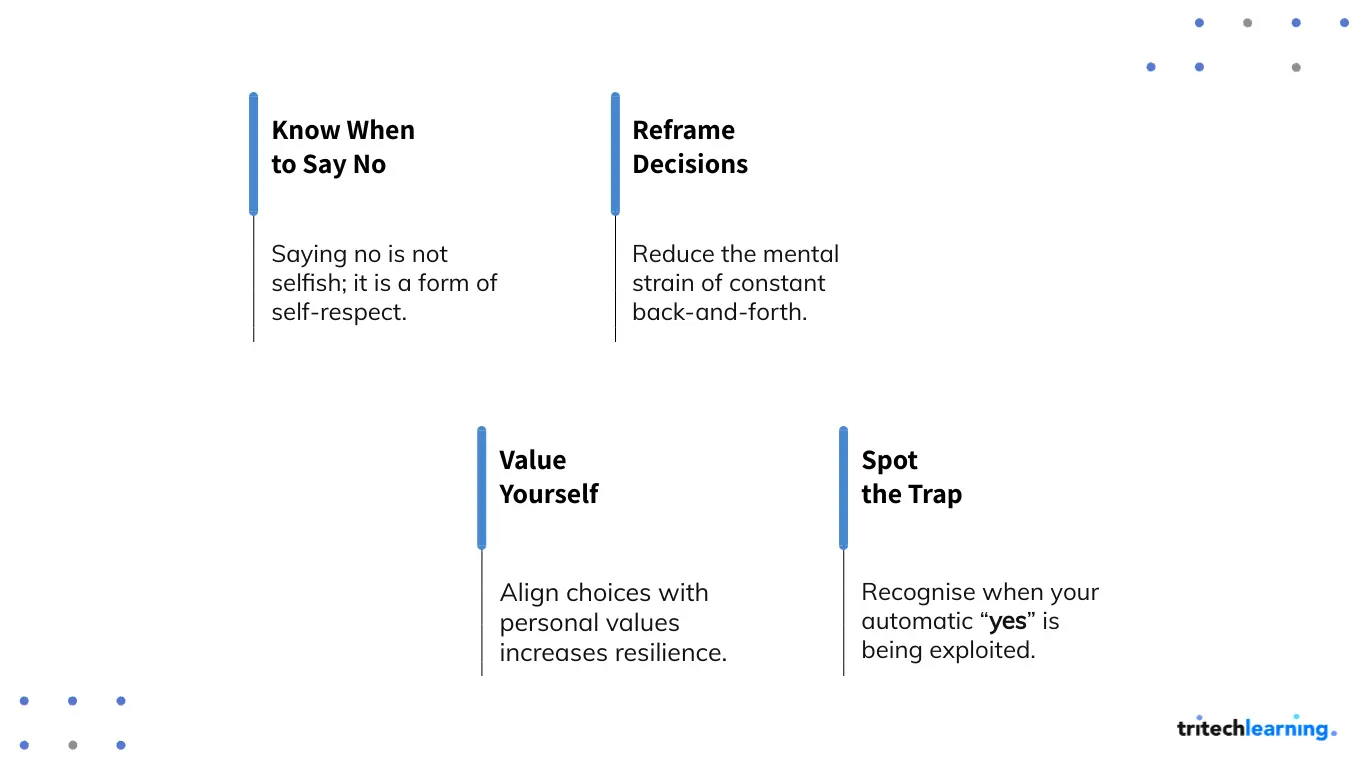
- Breaking free from "people pleasing" doesn’t mean becoming cold or avoiding social connections, finding healthy balance. Know When to Say No Knowing when to say no is essential. Each day brings far more requests than we can handle, and attempting to meet them all inevitably leads to overwhelm. Practicing simple responses such as “No, thank you” or “Not right now” protects your time and energy. Research shows that setting clear boundaries can reduce burnout by as much as thirty percent (HBR, 2021). Saying no is not selfish; it is a form of self-respect. Re-frame Decisions Re-framing decisions can also reduce the mental strain of constant back-and-forth. Instead of asking open-ended questions like “What do you want to eat?”, try offering a specific suggestion such as “I would like burgers. How does that sound?” This approach is clear, kind, and far more efficient. It reduces ambiguity, strengthens communication, and preserves mental energy for more meaningful interactions. Spot the Trap Spotting the trap is another important step. In many workplaces, people quickly learn who the reliable “yes person” is, and they often lean on that predictability. Becoming aware of this pattern is powerful. Research on self-awareness shows that increasing it can significantly reduce perceived stress (Eurich, 2018). Simply recognizing when your automatic “yes” is being exploited allows you to make more conscious decisions about when to help and when to step back. Value Yourself Valuing yourself is at the core of any change. Journaling about what matters to you clarifies your priorities and strengthens your sense of identity. Studies show that aligning choices with personal values increases resilience, direction, and mental clarity (Yaden et al., 2017). When you understand what you value, making confident decisions becomes far easier, and people pleasing loses much of its force.
- If you would like to explore this topic in greater depth, you can continue the journey in our course "Knowing Yourself: The Key to a Fulfilled Life". The course looks closely at people pleasing patterns and helps you understand where they come from, why they persist, and how to replace approval seeking with healthier forms of self respect and internal stability.
- We do not have to carry the weight of pleasing everyone forever. Change begins with small, intentional steps. Say no to one request this week. Or take the lead the next time you and a friend need to choose where to eat. Each moment in which you express your needs is an act of reclaiming your voice and strengthening your sense of self.
Growth begins with curiosity! At Tri Tech Learning, you’ll find free courses, webinars, presentations and articles that help you understand yourself and grow with purpose. To advance even further, explore our premium courses, workshops, and 1-on-1 coaching sessions, each designed to turn insight into meaningful, lasting change.
 Self‑paced
Efficient Learning: Master the Science of Learning
Efficient Learning: Master the Science of Learning is a course designed to explain how memory works, show how to use cognitive psychology to improve focus, and build habits that make learning practical, effective, and lasting.
€0€99
 Self‑paced
Knowing Yourself: The Key to A Fulfilled Life
Knowing Yourself: The Key to A Fulfilled Life is a psychology-based course that helps you build self-esteem, strengthen self-worth, and gain clarity about your identity, emotions, and personal growth.
€399
 Self‑paced
Emotional Intelligence: For Growth in Love, Work, and Life
Emotional Intelligence: For Growth in Love, Work, and Life will help you understand emotions, build empathy, and strengthen relationships with practical, research-based emotional intelligence skills.
€499