Caught in the Glow
It is common nowadays to see someone’s flawless social media feed and immediately assume they have their life perfectly together. We tend to believe that what appears on the surface reflects the entire story. This is a clear example of the Halo Effect, a cognitive bias where one positive trait, such as a polished appearance or a luxury item, leads us to assume that everything else about a person is equally impressive. With the rise of social media, this bias has only intensified. Many of us carefully curate our online presence to appear more successful, confident, or fulfilled than we really are. While it may seem harmless, the constant exposure to idealized images can distort our judgment, making us overlook warning signs or form unrealistic expectations of others and ourselves. Understanding how the Halo Effect shapes our perceptions is the first step toward seeing people (and ourselves) with greater clarity.
What’s the Halo Effect, Anyway?
Imagine seeing someone who is attractive and well-dressed. Our first assumption might be that they are also smart, kind, or trustworthy. We don’t have any real information that would justify this, but that’s often how our brains profile people right from the start. That’s the Halo Effect. It is a cognitive shortcut where one good quality casts a golden glow over everything else. A 1974 study by Landy and Sigall found that essays credited to attractive people scored between 15 and 20 percent higher than identical ones from less attractive individuals. No surprise there. Beauty can make us see talent or goodness that might not even be present.
This bias is not limited to looks. Charisma, fame, or a slick brand can have the same effect. But here’s the catch. That halo can hide flaws we would otherwise recognize easily.
When the Halo Backfires: Workplace Unfair Treatment
If you have spent some years in the corporate world, you might already be familiar with a classic example. A manager might rate an employee higher in teamwork just because they are punctual. Or they might hire a candidate simply because they are likable, not necessarily because they are qualified. It is human nature, but it can lead to poor decisions and unfair treatment.
I recall a story about a former manager at a company where I worked. A new hire who joined our team had a polished, confident presence, always well-dressed, always ready with a smooth explanation, and often seen preparing beautifully designed presentations or detailed-looking reports. He spoke with clarity and enthusiasm, which made everyone feel he really knew his stuff. Naturally, my manager was impressed and began to see him as a high-performing team member with great potential, eventually promoting him.
Over time, however, it became clear that most of the actual coding and project work was being handled by others on the team. The employee excelled at appearing competent rather than consistently delivering results. He wasn’t trying to deceive anyone; he simply understood how perception could shape reputation. When the manager eventually confronted him, he decided to leave for another job.
This was a perfect example of the Halo Effect in action. One person’s charm, confidence, and presentation skills created an overall impression of excellence that wasn’t entirely supported by the substance of their work.
Social Media: Where Halos Shine Brightest
Social media is the perfect environment for the Halo Effect. We curate our profiles with the best photos, clever captions, and aspirational vibes. It is fun and often feels innocent. It boosts our follower count and our ego. But it also creates a breeding ground for bias. A 2021 Nielsen report found that about 70 percent of shoppers trust well-known brands more, even without clear evidence, simply because of their polished image.
Influencers take full advantage of this. A perfect feed or a flood of likes can make us believe they are experts in everything, from skincare to life advice. This amplification is not always harmless. It opens the door for manipulation, both emotional and financial, especially when people exploit that trust.
The Dark Side: Blind Spots and Scams
Here’s where the Halo Effect can cause real harm. When we are dazzled by someone’s appearance, fame, or charisma, we often ignore warning signs, such as inconsistent behavior or broken promises. A report from the American Psychological Association in 2021 found that about 60 percent of couples cite unmet emotional needs as a major conflict source. Many of these issues begin when inconsistencies and unmet expectations are overlooked early in the relationship. That blind spot, often fueled by the Halo Effect, can lead to disappointing or even damaging outcomes.
Then there’s the more serious side. In 2023, the Federal Trade Commission reported a 40 percent increase in AI-driven celebrity impersonation scams. Victims lost an average of 1200 dollars. These scammers pose as public figures, using the “Halo” of fame to gain trust. From the outside, it seems ridiculous. But under the influence of the Halo Effect, it can feel completely believable. Whether it is love, money, or reputation, this bias can cost us dearly.
Breaking the Halo’s Spell
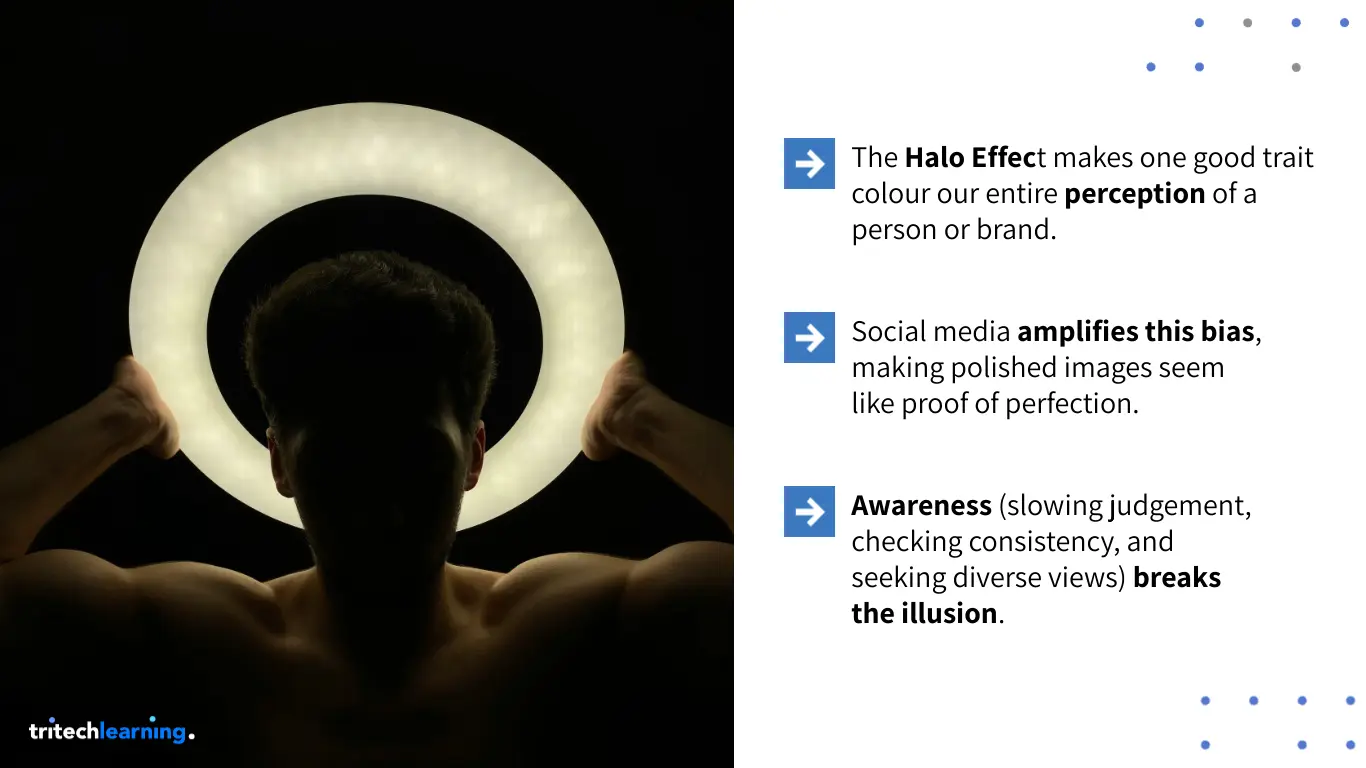
The Halo Effect Illusion
So, how do we stop falling for the illusion? The goal is not to become cynical or distrusting of others. It is about cultivating awareness and learning to see beyond surface impressions. The Halo Effect is subtle because it feels natural; our brains are wired to make quick judgments that simplify complex information. But awareness gives us choice. When we recognize how easily we can be influenced by appearances, confidence, or social status, we start making clearer, more grounded evaluations of people and situations.
Slow Down Your Judgments
When someone impresses you with their looks, charisma, or energy, take a mental pause. Before forming a conclusion, ask yourself, “Am I seeing the full picture, or am I reacting to one impressive trait?” This brief moment of reflection interrupts automatic thinking and allows space for more accurate observation. The more you practice slowing down your judgments, the easier it becomes to separate genuine competence from superficial charm. It is not about doubting others but about giving yourself time to think critically before assigning too much credit (or blame).
Look for Consistency
True character and competence reveal themselves over time through consistency. Rather than being swayed by someone’s confidence or eloquence, pay attention to whether their actions align with their words. In relationships, notice if care and respect are steady, not just occasional. In professional settings, look for reliability and follow-through. The same applies when evaluating public figures, influencers, or brands: read authentic reviews, seek factual information, and look beyond the polished image. Trust is built through repeated integrity, not through single moments of charm.
Diversify Your Sources
Our perceptions are shaped by what we see, read, and hear most often. When we rely on limited sources of information (especially those that reinforce what we already believe) we risk forming biased judgments. By deliberately exposing yourself to different viewpoints, communities, and content, you create mental balance and reduce the power of the Halo Effect. Listening to contrasting opinions or seeking out unfamiliar experiences encourages deeper understanding and helps you evaluate people and ideas more fairly. Awareness expands when you widen the lens through which you view the world.
Your Turn to See Clearly
The Halo Effect plays a huge role in modern digital life. It pulls us in with beauty, status, and curated perfection. But it can lead us to overlook flaws, waste money, or even experience emotional harm. Now that you understand how it works, you can navigate it with greater awareness and confidence. Next time you scroll, ask yourself: “Is this the full story, or just a halo?” Share your thoughts or personal stories below. Let’s learn to spot this bias and help others do the same.
Growth begins with curiosity! At Tri Tech Learning, you’ll find free courses, webinars, presentations and articles that help you understand yourself and grow with purpose. To advance even further, explore our premium courses, workshops, and 1-on-1 coaching sessions, each designed to turn insight into meaningful, lasting change.


 Self‑paced